


Everyone has their own ideas on the type of person who finds themselves in need of Cardaic Rehab. Peter Heathcote’s situation, like many, may surprise you.
My name is Peter Heathcote and on the 23rd of January 2025 early in the morning, I woke up in bed feeling not quite right, pain in the chest, pain in the arms, pain in the jaw and this worsened with some nausea. My wife fortunately, was at home with me, dialled 999 and we were told at that stage, that an ambulance would take up to two hours.
When I came to South Wales in 2005, I had joined and set up the first response unit in Newport alongside the Welsh Ambulance Service, dealing with cardiac arrests and Myocardial Infarctions. I was familiar with the urgency, importance of treatment early, getting to someone with a cardiac arrest as quickly as possible, to get that first aid in, to get that first care, to try and minimise the damage to the heart muscle and improve their chances of survival, and of course recovery.
So, hearing the ‘two hours’ was a little bit terrifying, I have to be honest! My condition worsened rapidly…
The ambulance service were fantastic, they were in constant contact my wife, talking to members of the family and telling them where the nearest defibrillator was, giving them the codes for the defibrillators in the area so that the defib unit could be on standby should I need it.
While this was happening, I was in a lot of pain – but also very aware that this could be the time when I was going to die, and that’s something that takes a lot of coming to terms with, a lot of realisation, a lot of thinking about it afterwards.
At the time I would say I felt quite calm, and I knew there was nothing I could do, and for someone who likes to do things, likes to be in control, likes to be adventurous in life ,it’s a really difficult thing to realise. There was nothing I could do, other than rely on the people around me, and the medical professionals that we’re going to be taking care of me, hopefully in the fairly near future!
I started to lose consciousness, I could hear but couldn’t really see much. I could hear the controller saying to my wife that my breathing was not effective and that I was only taking breaths about three times every minute. The pain in my chest had become so intense that I couldn’t speak, and obviously my respiration was very, very low. I then came round with four paramedics on site who were extremely professional, extremely caring and supportive.
They got me into the ambulance and got me to the Heath Hospital in Cardiff, where I went straight into the ‘Cath lab’ (Catheterisation laboratory) with only a very short delay. I had excellent care and service – one of the entertaining things for me at that time (if we can use the word entertaining!) was that one of the consultants said to me, ‘will you think about giving up smoking?’ and I said to him ‘consider that done doctor because I’ve never smoked in my life!’
I do enjoy a glass of wine but had, about a month before this event, had a full medical covering liver, kidneys, bones, cholesterol – everything was good. My Q score (a calculation used to estimate a person’s risk of developing cardiovascular disease) would have been really low, so the expectations of having a cardiac incident would also have been really low.
About seven days before the MI (Myocardial Infarction), I was bungee jumping in the jungles of Mexico, having an amazing time, trying different tequilas, having a really wonderful holiday, really adventurous!
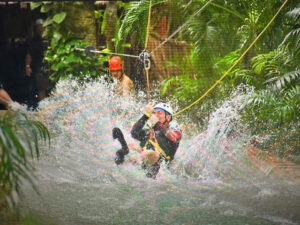
Bungee jumping in Mexico

Sampling the local tequilas
I climbed Coba, I went to Chichen itza and went to Tulum. People who were finding those adventures and activities difficult I just ran straight past them! So, I had no real symptoms or issues, I had no breathlessness, there was nothing really that would’ve alarmed me at that time.
The year before, I had ridden a horse called Madonna across the Andes in Peru and crossed the Salkantay mountains, along the Salkantay Pass – 15,200 feet above sea level and carrying the supplemental oxygen, but not actually needing to use it. I was taking Diamox to help, but again managed to cross the Pass over six days, riding at a high altitude and that was fantastic, a real experience of real adventure! A few years ago, I rode in Botswana with all the wildlife – lions elephants, wild dogs and hippos – I’ve always had an adventurous time and always try to be active.
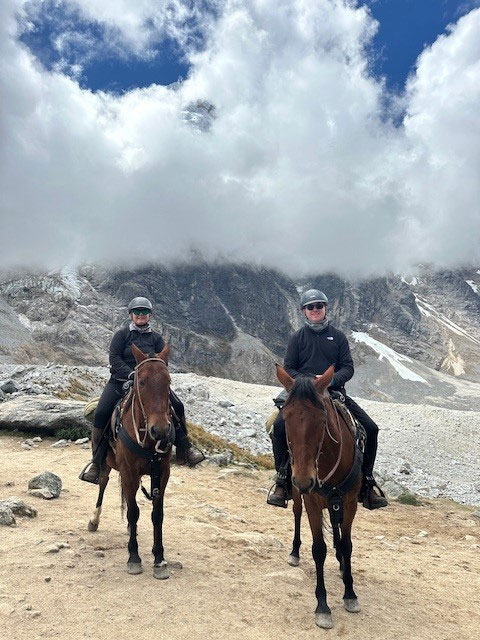
Riding along the Salkantay Pass

At the Salkantay mountains
I live on a smallholding and ride Icelandic horses as a hobby but also breed them. We have chickens, sheep, dogs and a farm cat. I’m riding again in Transylvania in September with bears, and really just getting out there and enjoying nature. That’s what I love, being outside, pottering around and not sitting still – so having a heart attack really would have been low on my list of expectations and it was a huge shock!
While I was in intensive care I was thinking, well I’ve tried to eat healthily, I’ve tried to control my weight, I’m trying to think about what I drink and make sure within reasonable parameters, and yet here I am with a 40% ejection fraction and the left anterior descending in what is called the ‘widow maker’.
In my case, four different medical professionals told me that if I hadn’t looked after myself, done all those things being so active, then I would be dead. They were very straight about it and it was real realisation for me, that I’m actually incredibly lucky! I’m lucky that I was here in the UK, I’m lucky the medics got to me and the facilities in the Heath were there. I’m very lucky that I had been so active and thought about those things through my life, and so I do feel very fortunate.
The Cardiac Rehab Team at St Woolos are people I’d never heard of and didn’t really know they existed – obviously I’d never had need of them. Yet when I came out of hospital, within 24 hours I’d been called and told I’d be in for an assessment quickly. They encouraged me to ring them with any questions I may have had. Going from taking no medication, nothing at all, to nine tablets every morning, was really something quite dramatic!
There was a regime to follow – I needed to take the Lansoprazole first, take a break, then needed to take the others. I was on three of the main forms of cardiac treatments – and now I’m on all four!
It was great to find the Cardiac Rehab team just saying ‘we’re here, ring us, ask us questions, you need to just pick up the telephone, leave as a message, we will ring you back the same day’ – and they did.
For example, I experienced strange things, like my arm felt numb, or just my feet were freezing cold or my hands were freezing cold. Sometimes I felt like I had a foreign body in the chest almost like a splinter, so it was really strange. Just being able to ring and say ‘what is this? what what’s happening?’ and having Ceri, who was my lead, say ‘It’s OK that’s perfectly normal, this is the drug that you’re taking, this is what it does. It’s nothing to worry about’ was reassuring.
Quite a lot of us who were in rehab would be talking and discover that we all had the same experiences. For example, we would wake up in the night with maybe a palpitation or just a little bit of discomfort – and suddenly the ‘3am Fear’ comes over you and you’re thinking; ‘is this going to happen again? am I having another heart attack? should I do something?’ – but of course, we all knew as soon as you start to get stressed and anxious, that is the worst thing for chest pain or feeling discomfort.
So for me, having the Cardiac Rehab team, having other people going through the same rehab that you can sit and talk to, was absolutely amazing! Just being able to say, ‘what is this? is this normal? do you get this?’ was a real blessing for me personally.
We are now fundraising for the St Woolos Cardiac Rehab Team to try and get them an Electrocardiogram machine (ECG) (a simple, painless test that records the heart’s electrical activity).
I guess the questions might be ‘Why? Why an ECG machine? Well, a lot of people who go to rehab need a quick check up with an ECG. With their own machine, the Cardiac Rehab team will be able to put their minds at rest quickly, without any delays and take away any undue stress.
Thank you to Peter and his family for allowing us to share his inspiring ‘Success Story’ – and his amazing efforts to fundraise for our fantastic Cardiac Rehab Team!
Click here to read the South Wales Argus article about Peter
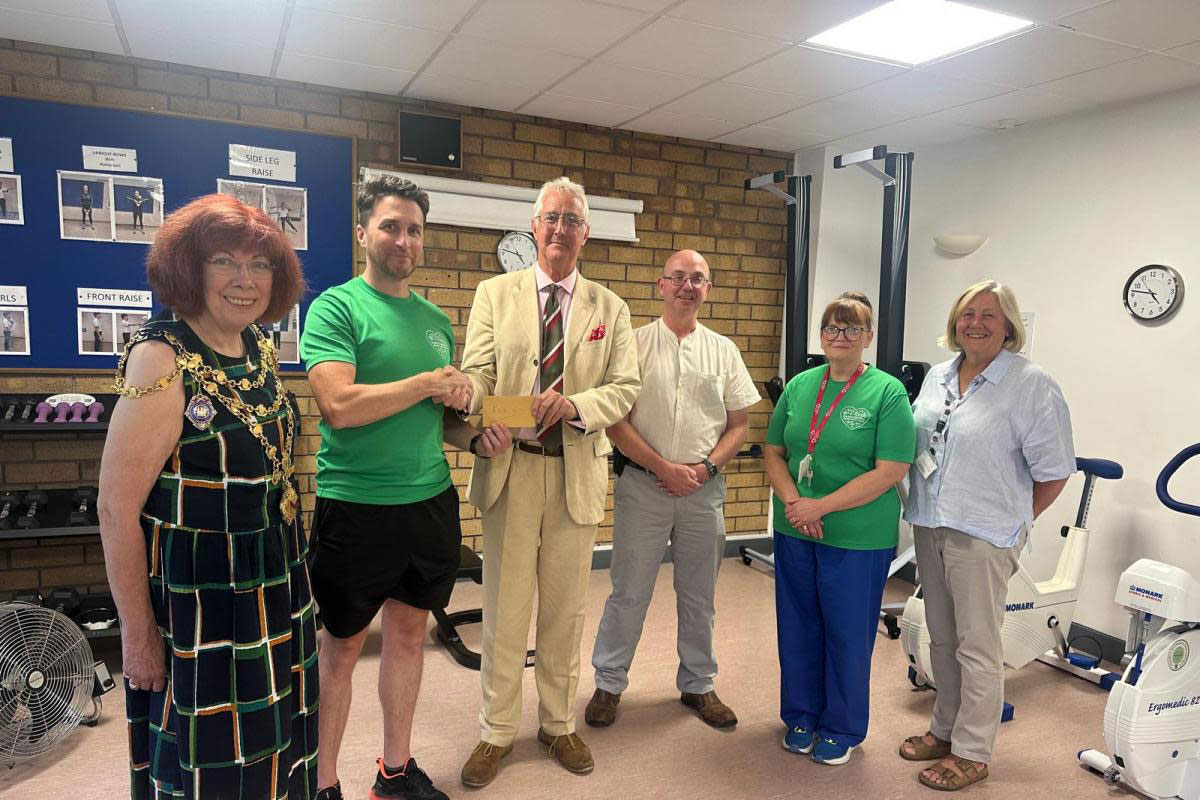
Presentation party, left to right: Linda Edmunds MBE, Ceri Kostin, Peter Heathcote, Brigadier Robert, Aitken, CBE, HM Lord Lieutenant of Gwent, Brian Begg, and the Rt Hon Kate Thomas, Lord Mayor of Newport, present a cheque for £2171 towards cardia
Cardiac Rehabilitation Centre
B Block, St Woolos Hospital
131, Stow Hill
Newport
NP20 4SZ
01633 238398
hello@gwentcardiacrehab.org.uk


